

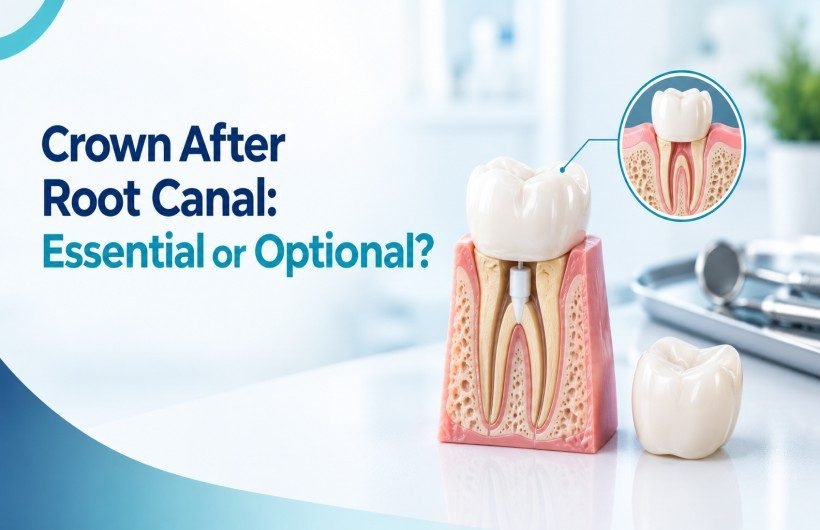
Do you need a crown after root canal treatment? For most back teeth, yes. Molars and premolars take the heaviest chewing load, and a crown after root canal is what keeps them from cracking. A front tooth with plenty of healthy structure left can sometimes do well with a strong filling instead, and an X-ray plus a clinical check shows which group your tooth belongs to. Patients ask us this almost every week at our dental clinic in Ahmedabad, so this guide gives the full picture.
Once the pain is gone, a root canal feels finished, and the crown starts to look like an optional extra with a second bill. That is the moment many patients stop. Understanding what the root canal changed inside your tooth makes the decision much easier.
Why Does a Root Canal Tooth Need Extra Protection?
A root canal removes the infected pulp, the soft tissue that holds the nerve and blood vessels. Your dentist cleans the canals, fills them, and seals the tooth, usually over 1 to 2 visits. The infection is gone, but the tooth has less structure than it started with.
The tooth was usually weakened before treatment even began, by deep decay or a large old filling. The dentist then opens an access hole through the biting surface to reach the canals. A treated tooth also tends to become more brittle over time, and it can no longer warn you with pain when a crack starts.
Picture a ceramic cup with a large chip along its rim. It holds your chai for months, then splits the day you pour boiling water into it. A tooth with a root canal and no crown is in a similar position, which is why a crown after root canal treatment matters so much. If you want the full background on the procedure itself, our guide to Root Canal Treatment in Ahmedabad covers symptoms, cost and recovery.
Which Teeth Almost Always Need a Crown After Root Canal?
A Dental crown after root canal treatment is strongly recommended when:
- The tooth is a molar or premolar. These back teeth carry the heaviest chewing pressure.
- Little healthy wall remains. Deep decay or a large old filling may have removed most of the tooth.
- The tooth has a crack or a thin wall that could split under pressure.
- You grind or clench at night, which multiplies the force on every back tooth.
- The tooth has darkened after treatment and you want the colour to match its neighbours.
When Can a Filling Be Enough After a Root Canal?
Some teeth dental clinic do well without a crown. A front tooth, such as an incisor or canine, usually takes less chewing force than a molar. If its walls are intact, the access hole is small, and your bite is normal, a bonded filling can restore it well.
Some molars with most of their walls intact may suit an onlay, which covers the chewing surface without shaping down the whole tooth. Even so, a filling protects less than a crown after root canal treatment does. We tell these patients plainly that the tooth needs regular Dental check-ups, and that a crown may become necessary later if a crack or a loose filling appears.
How Long Can You Wait for a Crown After Root Canal?
Right after your root canal, the tooth gets a temporary or core filling. The permanent restoration is usually planned 2 to 4 weeks later, once the tooth feels settled and the root filling has been checked. Some teeth need longer if they are still tender.
A temporary filling is built to last weeks, not months. It can wear down or loosen, which lets saliva and bacteria seep back in and can lead to reinfection. At our clinic, Dr. Charmi Patanvadiya looks at the X-ray, the remaining tooth walls, and your bite before recommending a crown or a filling.
Until the permanent restoration is placed, call your dentist if you notice any of these:
- The filling falls out or feels rough against your tongue.
- Pain returns when you bite down.
- Swelling, a pimple on the gum, or a bad taste appears.
Chew on the other side and avoid roasted chana, chikki, sugarcane and ice on the treated tooth.
What Happens If You Skip the Crown?
Many uncrowned teeth last for years, so skipping a crown after root canal treatment is a gamble rather than a guaranteed failure. The risk is a fracture. A crack above the gum line can often be repaired, while a crack that runs below it usually cannot, and the tooth then has to be extracted. Replacing it with an implant or a bridge generally costs more and takes longer than the crown would have.
The root canal itself can also fail if a leaking filling lets bacteria back in. That is why the final seal matters as much as the root filling.
What to Expect When You Get the Crown (Before, During and After)
Before: Your dentist takes an X-ray, checks the root filling, and tests your bite.
During: A crown after root canal treatment usually takes 2 visits. At the first, the tooth is numbed and reshaped, an impression or scan is taken, and you leave with a temporary crown. At the second, usually 1 to 2 weeks later, the permanent crown is fitted, the bite is checked, and it is cemented in place.
After: Mild soreness when biting is common for a few days. Brush and floss as usual, and with good care many crowns last 10 to 15 years. Material matters too, and our comparison of Zirconia vs Ceramic Crown explains how to choose.
Not Sure Whether Your Tooth Needs a Crown?
A short check usually settles it: an X-ray, a look at the remaining tooth walls, and a bite test. You can book an appointment at our Naranpura clinic and bring any earlier X-rays or treatment notes with you. We will tell you honestly whether your tooth needs a crown after root canal treatment or whether a filling is enough.
Frequently Asked Questions
Q: Is a crown always necessary after a root canal?
A: No. Back teeth almost always need one, while some front teeth with strong walls do well with a bonded filling. The decision depends on how much healthy tooth remains, not on the root canal alone.
Q: How soon should I get a crown after root canal treatment?
A: Usually within 2 to 4 weeks, once the tooth is comfortable and the dentist has checked the root filling. A temporary filling should not stay in place for months.
Q: Does a front tooth need a crown after root canal?
A: Not always. If the tooth has thick walls, a small access hole and a normal bite, a bonded filling may be enough. A front tooth that has darkened, cracked, or lost a lot of structure still benefits from a crown.
Q: Does a crown after root canal treatment hurt?
A: The tooth is numbed with local anaesthesia, so you should not feel pain during shaping or fitting. Mild soreness when biting can last a few days afterwards.
Q: What if I cannot afford a crown right now?
A: Tell your dentist early. They can often place a strong permanent filling now and schedule the crown for later, with check-ups in between. That is safer than leaving a temporary filling in place for months.
Protect the Tooth You Just Saved
If your root canal is finished and the crown is still on your to-do list, the tooth is at its most exposed right now. A crown after root canal treatment protects the work already done, and most back teeth need one. Dr. Charmi sees patients in Naranpura, Ahmedabad for exactly this decision. Chat with us on WhatsApp to share your X-ray or ask whether a crown or a filling suits your tooth.
This article is for informational purposes only and does not constitute dental or medical advice. Please consult Dr. Charmi Patanvadiya or a qualified dental professional for personalised guidance.